
C-03 / Building, drawdowns and grants
Construction Loans Parramatta
A lender writing construction loans Parramatta is funding a house that does not exist yet, which is why it wants a fixed price contract, council approval and your builder’s insurances in front of it before it commits to anything.
That order of work is most of what separates a straightforward build from a stalled one. Line up the contract and the approvals first and the finance follows them. Start with the finance and you spend the next three months going back to your Parramatta builder for documents that should have been settled before anyone signed.
What We Set Up for Your Build
We arrange the finance around your building contract rather than the other way round: a loan sized to the land and the construction together, a drawdown schedule matched to your Parramatta builder’s payment stages, and a lender comfortable with your contract and your builder.
Then we run the drawdowns. Each stage needs an inspection or a valuer’s sign-off before the lender releases funds, and that process is where builds stall if nobody is managing it. Your builder wants to be paid on completion of each stage, and a slow release becomes your problem rather than the bank’s.
We also check the grant position early, because it is decided by the numbers in the contract and there is nothing to be done about it afterwards.
How We Run Your Build Loan, Stage by Stage
A construction loan has more moving parts than a purchase, so it helps to see the whole sequence before starting. Nothing is lodged until the contract is settled.
-
We look at the contract and the land
The fixed price contract, the land position, City of Parramatta approval and the builder’s insurances. You find out early whether anything in that set will cause a problem, which is far better than discovering it once you have committed to a builder.
-
We size the loan against the finished value
Land plus construction, assessed against what the Parramatta property will be worth complete. That valuation is where build finance most often falls short, so it gets tested before an application rather than after.
-
We set the drawdown schedule
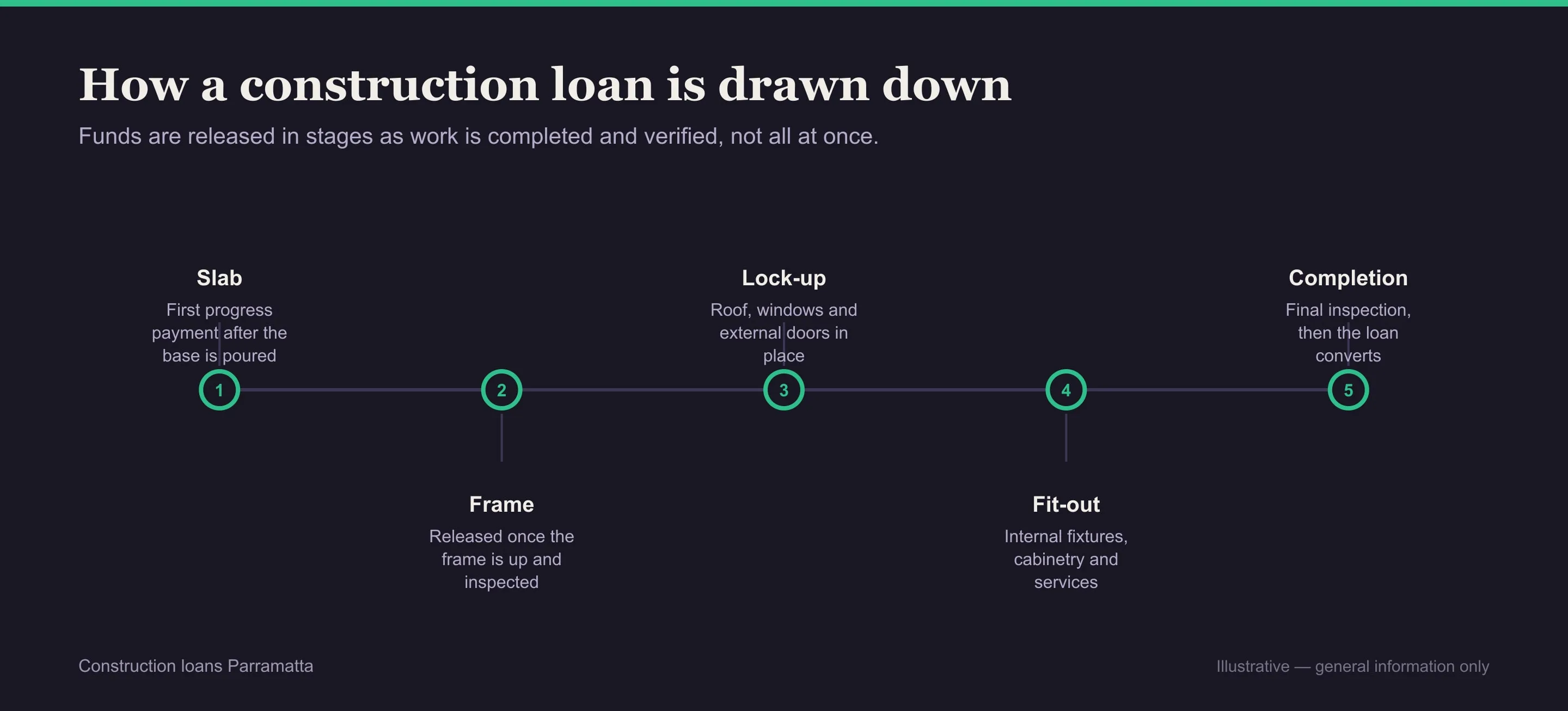
Payment stages matched to your builder’s contract, so slab, frame, lock-up, fit-out and completion each release the right amount. You pay interest on what has been drawn, not on the full loan, which keeps costs down through the build.
-
We manage each release and the grant claim
Every stage needs sign-off before funds move. We handle that with the lender and the valuer so your Parramatta builder is paid on time, and we make sure the grant claim goes in if your project qualifies.
Useful to have to hand: the fixed price building contract or the builder’s quote, the plans, the land contract or your current title, and council approval if it has come through. A quote alone is enough to start.
Before You Sign With a Builder
What do you need to set up a build loan?
The fixed price building contract, the plans, the land contract or your existing title, and council approval once it has come through. The builder’s insurances are needed before funds are released rather than at the start.
If you are still choosing a builder, a quote is enough to work out what the finance looks like. It is a better time to talk than after you have signed.
Does it cost me anything to arrange the construction finance?
No, it costs you nothing. The lender pays us a commission when the loan settles, and it covers the drawdown management as well as the application, so the ongoing work through the build is not a separate cost to you.
If a fee ever applied to your circumstances, it would be set out in writing in our Credit Guide before you decided whether to go ahead.
What happens if my builder goes under mid-build?
The immediate protection is home warranty insurance, which every licensed builder must hold and which is one of the documents the lender requires before releasing funds. It is there for exactly this.
On the finance side, the loan stops drawing down, and the remaining stages get restructured around a replacement builder and a revised contract. It is disruptive, but it is a known situation with a known process rather than an unrecoverable one. Having the loan managed by someone who has handled it before is worth a good deal at that point.
Who chases the bank for each progress payment?
We do. Each stage needs an inspection or valuer sign-off before the lender releases funds, and that is our job to arrange rather than yours or your builder’s.
It is the part of a build loan most likely to cause friction, because a builder waiting on a payment is a builder not starting the next stage. Somebody has to own it.
How Construction Loans Parramatta Pay Your Builder
The lender does not hand you the money. It releases it in progress payments tied to the building contract, usually at slab, frame, lock-up, fit-out and completion, and each release requires the stage to be verified before funds move.
The useful consequence is that interest is charged only on what has been drawn. Early in the build, when only the slab has been paid for, your interest cost is small. It rises as the build advances, and most construction loans are interest only through the build before converting to a normal principal and interest loan at completion.
The part that needs managing is the timing of each release. Builders expect payment on completion of a stage and a delay in the lender’s inspection becomes a delay in your build. Chasing that is a real part of the job, and it is the reason a Parramatta build loan benefits from someone watching it rather than a loan that simply settles once.
Why the New Home Grant Rarely Reaches a Parramatta Build
The First Home Owner Grant is $10,000 and it applies only to new homes. The caps are the problem: a newly built home valued up to $600,000, or a land purchase plus building contract with a combined value up to $750,000. Those are the thresholds, and above them the grant is not reduced, it simply does not apply.
Read against local prices, a new house built in Parramatta will rarely land under either figure once land is included. That is worth knowing before you build a plan around the grant, because it is a common assumption and an expensive one to carry into a contract.
Where it does reach is land and build packages further out from Parramatta, and some new apartment stock under the $600,000 cap. If the grant matters to your budget, the honest answer is that it will shape where you build rather than being a bonus on top of a decision already made. We check the numbers against your contract early so you are not planning around money that was never available.
The Valuation Your Lender Does Before Anything Exists
A lender funding a build values the property "as if complete": what it will be worth once finished, based on the plans, the specification and the contract price. That figure sets your loan, so it carries the same weight as a valuation on an existing house, but it is an assessment of a drawing rather than a building.
Where that goes wrong is when the finished value comes in below land plus construction cost. It happens on over-specified builds, unusual designs and knockdown rebuilds where the money going in exceeds what the finished house will fetch on that Parramatta street. The gap becomes cash you have to contribute.
Because it depends on the plans and the contract, it can be tested early. We would rather know before you sign with a builder than have you discover it at application, when the contract is already binding and the options have narrowed to finding more cash.
House and Land, or Knocking Down What You Already Own
These are financed differently and it is worth being clear which one you are doing. A house and land package is generally two contracts, one for the land and one for the build, and lenders treat them as a sequence: the land settles first, then construction draws down against it.
A knockdown rebuild uses the equity in a property you already own, and the lender is funding a build on land that is already yours. That usually means fewer moving parts, though it introduces its own question, which is where you live in Parramatta during the build and how that cost sits alongside the loan.
Both need the same evidence: a fixed price contract, council approval and the builder’s insurances including home warranty cover. A cost plus contract, where the final price is not fixed, is much harder to finance and some lenders will not fund one at all. If your builder is proposing one, that is a conversation to have before signing rather than after.
Drawdowns, Grants and Contracts
How does a construction loan actually work?
The loan is approved for the full amount but released in stages against your building contract, typically slab, frame, lock-up, fit-out and completion, with each stage verified before funds move.
You pay interest only on what has been drawn, which keeps costs low early on. Most build loans are interest only through construction and convert to a normal principal and interest loan once the house is finished.
Do I get the first home owner grant if I build?
Only if the numbers fit. The grant is $10,000 on a new home valued up to $600,000, or land plus building contract up to $750,000 combined. Those caps are hard edges rather than sliding scales.
Building a new house in Parramatta will usually exceed both once land is counted. It reaches further out, and it reaches some new apartment stock. Check it against your actual contract before you rely on it.
What is a fixed price contract and why does the lender insist?
A contract where the builder commits to a total price for the work described, rather than charging costs as they arise. It gives the lender a figure to lend against and gives you certainty about what the build will cost.
A cost plus contract, where the final price is open, is considerably harder to finance and some lenders will not fund one at all. If a builder proposes it, understand what you are taking on before you sign.
Where do I live while the house is being built?
Wherever you can, and the cost of it belongs in the budget. On a knockdown rebuild you are usually renting for the duration while also paying interest on the drawn portion of the loan, and those two together are the part most people underestimate.
Lenders count rent as a commitment in their assessment, so it also affects what you can borrow. It is better to have it in the numbers from the start than to be surprised by the servicing calculation.
Can I build on land I already own?
Yes, and it is often the simpler version. The equity in the land or the existing house forms part of the security, so there is no separate land settlement to coordinate, and a well-held property can significantly reduce what you need in cash.
The valuation is still done as if complete, so the same caution applies: if the finished value would not cover land plus build cost, the difference has to come from you.
Who Runs Your Drawdowns
The same broker from the contract review to the final payment. A Parramatta build runs for a year or more and involves your builder, a valuer and the lender at every stage, and the person coordinating that needs to have been there from the start.
It also means there is somebody to ring when a payment is late. That is the most common thing to go wrong on a build loan, and it is a lot easier to fix through someone who already has the file open.
- Phone (02) 7813 2050
Quickest if you have a property in front of you and a question about it.
- Form Use the enquiry form
Better if you are on site or at work and cannot take a call back.
- Email info@mortgagebrokerparramatta.au
Suits a contract, a floor plan or a loan statement you want read.
Parramatta NSW 2150. Monday to Friday, 9am to 5pm.
Talk to Us Before You Sign With a Builder
Send the quote or the Parramatta contract and we will come back with what the finance looks like, how the drawdowns would be scheduled, whether the finished value supports the build and whether the grant reaches your project. Much easier before the contract is signed than after.
Where We Work
- Business
- Mortgage Broker Parramatta
- Location
- Parramatta NSW 2150
- Phone
- (02) 7813 2050
- info@mortgagebrokerparramatta.au
- Hours
- Monday to Friday, 9am to 5pm