
A-02 / Buying before it is built
Off-the-Plan Home Loans Parramatta
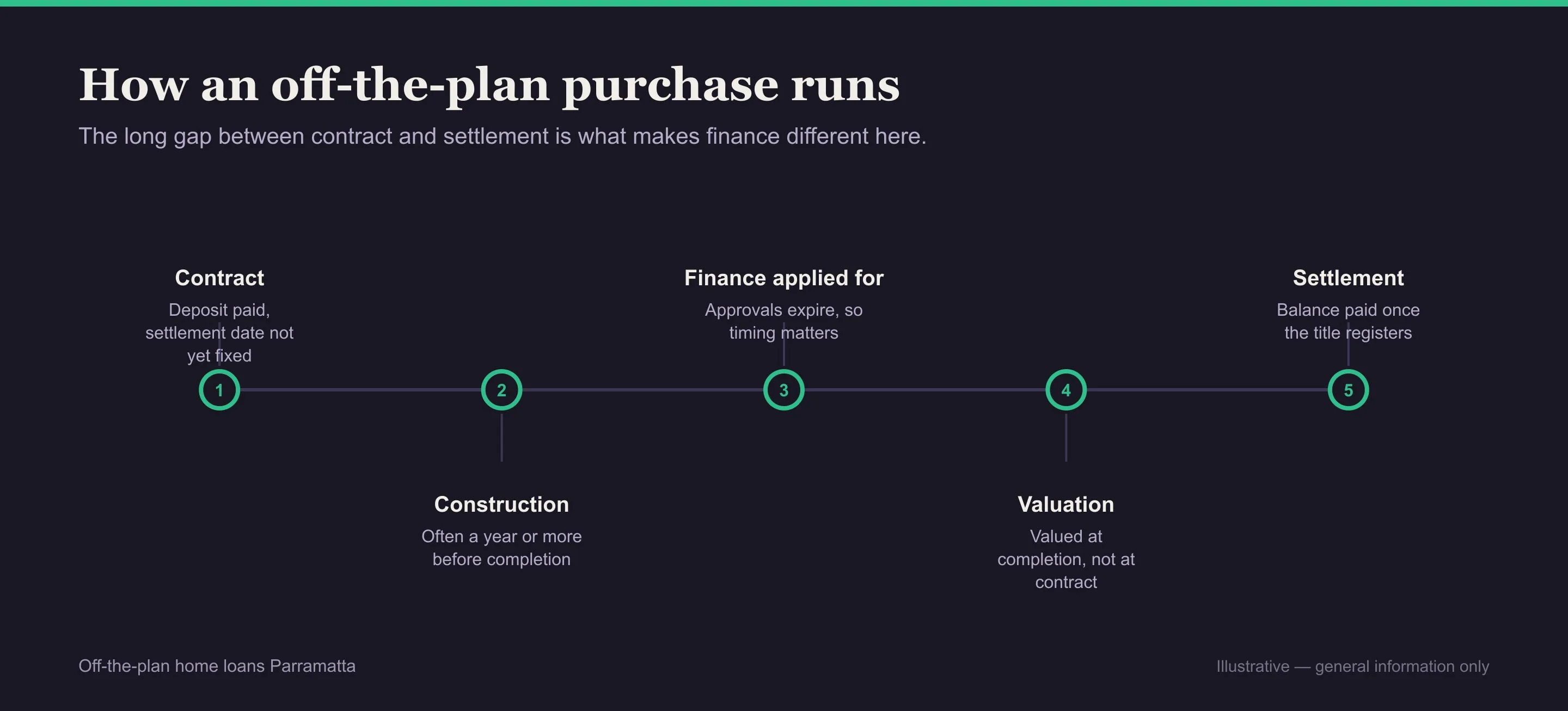
You sign in 2026 and settle in 2028, which is why off-the-plan home loans Parramatta are approved twice: once on a promise, and once on a building that exists. The second approval is the one that catches people, because the bank lends against what the finished apartment is worth on the day rather than against what you agreed to pay two years earlier.
If those two figures do not meet you cover the difference in cash at settlement, and the deposit you already paid does not count towards it. What closes a gap like that on a Parramatta tower is cash, a larger contribution, or a lender that reads the finished building differently, and all three are easier to arrange in 2026 than in the fortnight before completion.
What We Do Across a Two Year Build
Off-the-plan finance is two jobs separated by a long wait. Up front we assess what you can borrow, read the finance terms in the contract, and tell you what a shortfall at completion would cost you in cash if it happened. Then, when the building is registered, we lodge the real application against the real valuation.
In between we keep the file current. Your income changes, lender policy changes and the building itself gets classified once it exists, so the loan approved at completion is rarely the one you would have been given on the day you signed. That is normal, and it is manageable if somebody is watching it.
Most people arrive here at one of two moments: holding a Parramatta contract they have not signed and wanting to know the risk, or six months from completion and realising nobody has looked at the finance since the launch weekend.
How We Work an Off-the-Plan Purchase
The work is split across the build rather than done in one sitting. What follows is the shape of it, from the Parramatta contract in front of you now to the keys.
-
We read the contract before you sign
The finance clause, the completion window, the sunset date and how the developer has structured the deposit. You get told what each of those means for you in plain terms, and where the contract puts risk on your side rather than theirs.
-
You get a shortfall figure, not a reassurance
We work out what a valuation five, ten and fifteen per cent under your price would mean in extra cash at completion. If that number is one you cannot cover, far better to know it now than to find out with a settlement date fixed.
-
We hold the file open through the build
A pre-approval lasts three to six months and a build does not, so we check in as your circumstances move and as lender policy shifts. Nothing is lodged in the meantime, because an application made two years early is worth nothing at completion.
-
We lodge and manage the valuation at completion
When the building is registered we apply for real, choose the lender whose panel and policy suit the finished Parramatta development, and press the valuation where there is a case to. Then we run it through to settlement with your conveyancer.
Useful to have to hand: the contract of sale, the developer’s completion estimate, the price and deposit, and a rough picture of your income and savings. If you only have the brochure, that is a fine place to start.
What You Will Want to Know First
When in the process should I be talking to a broker?
Before you sign, if there is any choice about it. The shortfall arithmetic and the contract clauses both belong ahead of the signature, and neither takes long enough to be worth skipping under pressure from an agent.
The second point that matters is roughly six months out from completion, when the real application gets built. Between those two the file mostly sits, which is why nobody hears from their bank for two years and then panics.
Do you charge to look at an off-the-plan contract?
No. We are paid a commission by the lender when a loan settles, so reading the contract, working the shortfall numbers and telling you not to sign all cost you nothing.
If a fee ever applied to your circumstances, it would be set out in writing in our Credit Guide before you decided whether to go ahead. Nothing arrives after the fact.
I have already signed. Is it too late to get help?
Not at all, and this is a large share of the work. Plenty of people sign at a Parramatta launch, hear nothing for eighteen months and then want somebody looking at the finance before completion arrives.
The earlier in that window we start the more room there is, particularly if a valuation is likely to come in short or your income has changed since you signed. Six months out is comfortable. Six weeks out is tighter but still worth doing.
Who actually looks after my file through a two year build?
The same broker throughout. That is the point of the arrangement: the person who read your contract is the person who knows why the sunset date matters and what your shortfall plan was.
A long build is exactly where a file passed between desks goes wrong, because the context lives in someone’s memory rather than in the notes.
The Valuation Gap That Decides Off-the-Plan Home Loans Parramatta
A lender does not fund a percentage of what you agreed to pay. It funds a percentage of the lower of the contract price and the valuation, and on an off-the-plan purchase those two numbers are separated by the entire build. If the market softened, if the developer was pricing optimistically at launch, or if comparable sales in the building came in under expectations, the valuation lands below your price and the shortfall is yours in cash.
Five to fifteen per cent is the range that turns up often enough to plan around. On a contract signed at the top of a cycle it can be worse. The part buyers rarely realise is that the shortfall is paid on top of the deposit already handed over, at the moment of settlement, when there is no time left to raise it.
Two things help. The first is knowing the number in advance so you can hold cash against it or negotiate the price down before signing. The second is the valuation itself: different lenders use different valuer panels, and panels do not read a Parramatta building identically. Choosing where the application goes is a real lever, and it is the main reason not to lodge with whoever ran the launch-day finance desk.
Why Deferring Your Duty Is Not Saving It
NSW lets many off-the-plan buyers defer transfer duty rather than pay it at exchange. Under section 49A of the Duties Act it can be deferred for up to twelve months from the date of the agreement, or until the property is completed or the contract assigned, whichever comes first. It is available if you intend to live in the property, and there are residence conditions attached.
Deferral is not a discount. The same duty is payable, later. It is a cash flow benefit and a real one, because it keeps money in your account through the build instead of with Revenue NSW, but read it as a saving and you arrive at completion short by the full amount.
We flag it, we make sure it is in your settlement figure, and we size your loan around the duty being payable rather than around the deferral. Your conveyancer handles the claim itself; our job is making sure the finance was built with the bill in it.
What Your Contract Lets the Developer Do
A sunset clause lets either party walk away if the building is not registered by a fixed date. Historically that was used by developers to cancel contracts and resell at a higher price. Section 66ZS of the Conveyancing Act now stops a developer rescinding under a sunset clause without either your written consent or an order of the Supreme Court, which is meaningful protection, though it does not make the sunset date irrelevant to you.
The other clause worth reading properly is finance. Many Parramatta off-the-plan contracts are unconditional, so the risk of not being approved at completion sits with you rather than being an exit. That is exactly why the shortfall arithmetic belongs before the signature, not after.
We are not your lawyer and we do not pretend to be. What we do is read the contract for what it means to the finance, tell you which clauses will decide whether you can settle, and say plainly when something should go to your conveyancer before you sign anything.
Defects, Cladding and Whether a Parramatta Building Can Be Funded
NSW built a regime around this after a run of high-profile failures. The Design and Building Practitioners Act 2020 requires declared designs and registered practitioners. The Residential Apartment Buildings Act 2020 gives the Building Commissioner power to inspect a development and to stop an occupation certificate being issued. Developers of residential strata buildings of four storeys or more must lodge a building bond of two per cent of the contract price. Project Remediate exists to fund the removal of combustible cladding on affected buildings.
iCIRT sits alongside all of that: an independent rating of builders and developers from zero to five stars, covering their track record and financial capacity. It is not a lender requirement, but it is public, and it is one of the few ways to look at who is actually building your apartment rather than at the render.
Why it matters to the loan: a building with an unresolved defect notice, cladding under remediation or an occupation certificate held up can become difficult to finance at exactly the point you need to settle. We check what is known about the developer and the Parramatta building before you commit, and if something surfaces during the build we go looking for a lender that can still work with it.
The Contract and the Building
Can I get a home loan approved before the building is finished?
You can get a pre-approval, and it is worth having, but it will not survive the build. Pre-approvals run three to six months. A Parramatta tower typically takes two years or more from contract to registration.
So the real application happens near completion, against the finished building and a current valuation. Anyone telling you the finance is locked in at exchange is describing something that does not exist.
What happens if the valuation comes in below my contract price?
The lender funds its percentage of the valuation rather than of your price, so the difference becomes cash you have to find at settlement, on top of the deposit already paid.
There are moves available: ask for a review with fresh comparable sales, take the application to a lender using a different valuer panel, or restructure the loan so the loan-to-value ratio still works. All of them are easier if the possibility was planned for rather than discovered.
Can the developer cancel my contract and resell the apartment?
Not freely. Section 66ZS of the Conveyancing Act means a developer cannot rescind under a sunset clause without your written consent or an order of the Supreme Court, which was introduced precisely because the practice was being abused.
The sunset date still matters to you though, because a long delay affects your finance, your deposit and any plans built around a completion month. Read it, and know what it says before you sign.
How do I check the builder before I commit?
iCIRT is the most useful public source. It rates builders and developers from zero to five stars on track record and financial capacity, independently of the marketing.
Alongside that, NSW now has real teeth on new apartments: declared designs under the Design and Building Practitioners Act, the Building Commissioner’s power to block an occupation certificate under the Residential Apartment Buildings Act, and a two per cent building bond on strata buildings of four storeys or more.
Are off-the-plan home loans Parramatta harder to get than a loan on an existing unit?
The loan itself is an ordinary home loan. What is harder is the timing and the property risk around it: a valuation two years after you fixed the price, a building that does not exist yet to be assessed, and lender policy that may have moved in the meantime.
None of that is a reason to avoid buying off the plan. It is a reason to have the finance managed across the build rather than arranged twice by two brokers who never spoke to each other.
Who Holds Your File Until Completion
One broker, from the contract read to the settlement. On a purchase that runs two years that continuity is most of the value, because the reasons behind a decision made at exchange are the ones that matter at completion.
We work with a lot of the new stock going up around the Parramatta CBD and Westmead, so we tend to know which lenders have been comfortable with which developments and where valuations have been landing. That is current knowledge, and it goes stale, which is why it is worth asking rather than assuming.
- Phone (02) 7813 2050
Quickest if you have a property in front of you and a question about it.
- Form Use the enquiry form
Better if you are on site or at work and cannot take a call back.
- Email info@mortgagebrokerparramatta.au
Suits a contract, a floor plan or a loan statement you want read.
Parramatta NSW 2150. Monday to Friday, 9am to 5pm.
Have the Contract Looked At
Send the Parramatta contract and the completion estimate and we will come back with what you can borrow, what a valuation shortfall would cost you and which clauses will decide whether you can settle. Better before the signature than after it.
Where We Work
- Business
- Mortgage Broker Parramatta
- Location
- Parramatta NSW 2150
- Phone
- (02) 7813 2050
- info@mortgagebrokerparramatta.au
- Hours
- Monday to Friday, 9am to 5pm