
C-01 / Business, contract and sole trader income
Self Employed Home Loans Parramatta
We spend more time on self employed home loans Parramatta than on any other kind we write, and it is always the same problem. Your accountant spends the year legitimately reducing your taxable income, and then a lender reads that reduced figure as everything you earn.
The discipline that keeps your tax bill sensible is what makes a bank think you cannot afford a mortgage. That is solvable, but only with the right reader, because the same set of returns can produce very different borrowing figures depending on which lender opens them. Which one you go to matters more on a Parramatta self-employed file than it does for anyone on a payslip.
What We Do With Your Business Figures
We read the returns the way a Parramatta credit assessor will, work out what your assessable income comes to once legitimate add-backs are restored, and then match that against the lenders whose policy suits your structure and your trading history. What comes back is a borrowing figure and a document list, not a general encouragement to apply.
Structure changes the answer more than people expect. A sole trader, a company director drawing a wage plus dividends, a contractor on a long-term arrangement and a partner in a partnership all present differently, and lenders that handle one well can be difficult with another.
You are most likely here after a bank has told you no on a business that is plainly doing fine, or before you apply, because you have heard it is hard and want to know what you are walking into.
How We Work a Self-Employed File in Parramatta
The order is deliberate: the income question gets answered before anything else, because everything else follows from it.
-
You tell us how the business is set up
Sole trader, company, trust or partnership, how long it has traded in Parramatta or anywhere else, and roughly how the last two years went. That is enough to know which document path applies and which lenders are worth approaching.
-
We work out your assessable income
We read the returns and restore the add-backs Parramatta lenders accept, so you find out what your income looks like to a credit assessor rather than to the tax office. It is frequently a good deal higher than the figure on the front page of the return.
-
We choose the document path and the lender
Full documentation where the returns support it, alternative documentation where they do not. Then the lender whose policy reads your Parramatta business structure best. You get told why that lender and not another.
-
We lodge and handle the questions
Self-employed files in Parramatta attract more questions from assessors than salaried ones, and a good response the first time avoids a decline. We deal with those rather than forwarding them to you, and run it through to settlement.
Useful to have to hand: your last two years of personal and business tax returns, recent BAS, business bank statements, and a note of any one-off expenses in the figures. If you only have one year, that is a conversation worth having rather than a reason to wait.
What You Should Ask Us First
What documents do you need if I work for myself?
For the full documentation path, two years of personal and business tax returns with the notices of assessment. If we are going down the alternative documentation route it is business activity statements, business bank statements or a declaration from your accountant instead.
Start with whatever you have. Part of the job is working out which path suits your figures, and that decision is easier to make with the documents in front of us than in the abstract.
Does it cost me anything to have you read my figures?
No, it costs you nothing. The lender pays us a commission when the loan settles, and it is the same arrangement whether your income comes from a payslip or a business, so reading your returns and working out the add-backs is free to you.
If a fee ever applied to your circumstances, it would be set out in writing in our Credit Guide before you decided whether to go ahead.
What happens if my figures are messy?
Not usually, and it is far more common than clean ones. Businesses have unusual years, one-off costs and structures that do not fit a form. What matters is that the picture can be explained and evidenced.
What does cause problems is leaving things out in the hope they will not come up. An assessor finding something unexplained late is much worse than the same thing framed properly at the start.
How much of my time will this take?
The first conversation is short, and after that most of the effort is ours. Gathering the documents is the part that falls to you, and if your accountant holds them it is often quicker to ask them directly.
We handle the questions that come back from the assessor, which on a self-employed file is where most of the back and forth happens. You should not be explaining your own depreciation schedule to a bank.
What Your Lender Asks For, and When One Year Is Enough
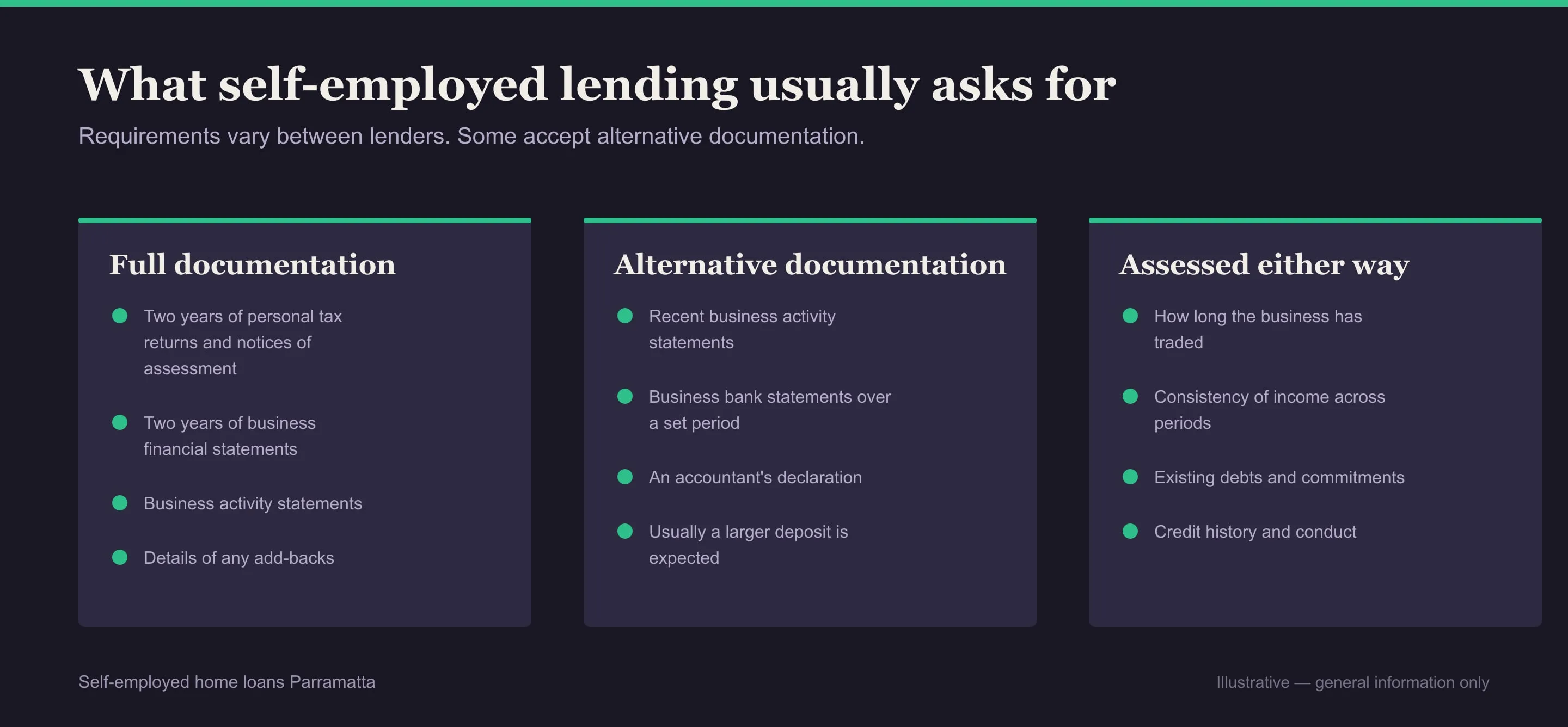
The standard path for self employed home loans Parramatta is full documentation: two years of tax returns, personal and business, along with the notices of assessment. That is what most lenders want and it is the cleanest route where the figures support the borrowing.
Some lenders will work from a single year of returns. That is not a fringe product and it is not a penalty rate proposition, but it is a smaller field of lenders, and the year in question needs to stand up on its own. If you started trading eighteen months ago and the business is doing well, waiting for a second return is a choice rather than a requirement, and it is worth costing out before you assume.
Where returns are not the right evidence, alternative documentation uses business activity statements, business bank statements or a declaration from your accountant instead. It suits businesses with recent growth the returns have not caught up with, and it comes with its own conditions rather than being an easier version of the same thing.
Add-Backs, and Getting Your Real Income Counted
An add-back is a deduction the lender restores to your income because no cash actually left the business. Depreciation is the clearest example: it reduces your taxable profit without anyone writing a cheque, so most lenders add it straight back.
The others worth knowing about are one-off expenses that will not repeat, additional superannuation contributions above the compulsory amount, and interest on a debt that is being cleared as part of the transaction. Each of those can lift your assessable income materially, and on a modest profit the difference between the tax figure and the assessed figure can be the difference between a decline and an approval.
Lenders do not treat add-backs identically. Some accept the full list, some accept part of it, and some want the accountant to confirm the item in writing. Knowing which lender takes which is exactly the sort of unglamorous detail that decides these applications, and it is why the same set of figures gets different answers at different banks.
What We Do When Your Two Years Do Not Match
Lenders like consistency, and a business rarely provides it. The two patterns that come up constantly are a strong recent year following a weaker one, and a strong earlier year followed by a dip.
Where the most recent year is the better one, many lenders will average the two, which drags your assessed income below what the business is currently producing. Others will use the most recent year if the growth can be explained and supported. That difference is worth finding before you apply rather than after.
Where the recent year is weaker, expect questions, and expect the lower figure to be the one used. If there is a reason for the dip, a one-off cost, a client lost and replaced, a deliberate investment in the business, document it properly and it can be dealt with. Ignored, it reads as a business in decline, which is a different conversation entirely.
Why Lender Choice Matters More on Self Employed Home Loans Parramatta
Western Sydney carries a large population of small business owners and contractors, and Parramatta’s commercial base means a good share of the borrowers we see here are assessed on business income rather than a payslip. That does not make the lending unusual, but it does make lender selection the main variable.
A salaried applicant with a clean file gets a broadly similar answer from most lenders. A self-employed applicant does not. The spread between the most and least accommodating lender on the same set of figures can be very wide, because policy on add-backs, trading history and document type differs at every one of them.
That is the whole argument for going through a panel rather than to the branch on Church Street in Parramatta. It is also why a decline from your own bank is genuinely poor evidence about your borrowing capacity: it tells you about that lender’s policy, and nothing about the other thirty-odd.
Documents, Add-Backs and Trading History
Can I get a home loan with only one year of returns?
Yes, with some lenders. It is a narrower field than the standard two-year path but it is ordinary lending rather than a last resort, and the pricing is not automatically worse.
The single year has to stand up on its own, and the business generally needs to look established rather than brand new. Whether to use it or wait for a second return is worth working out on the numbers, because waiting has a cost too.
What exactly are add-backs?
Deductions in your accounts that a lender adds back to your income because no cash actually left the business. Depreciation is the main one, alongside genuine one-off expenses, additional superannuation above the compulsory amount, and interest on debt being cleared through the transaction.
The effect can be large. A business showing a modest taxable profit can assess considerably higher once they are restored, which is often the whole difference between the answer you got from your own bank and the answer available elsewhere.
Do sole traders get worse terms than company directors?
Not inherently. What differs is how the income is evidenced: a sole trader’s business income flows through the personal return, while a director may draw a wage and take dividends, and lenders read those two differently.
The structure that suits you for tax is not always the one lenders find easiest, and it is not worth restructuring a business around a loan. The better move is choosing a lender whose policy already fits how you are set up.
What if my last year was much stronger than the year before?
It depends entirely on the lender. Many will average the two years, which holds your assessed income below what the business is currently earning. Others will use the most recent year where the growth can be explained and supported.
That is a difference worth thousands in borrowing capacity, and it is decided by where the application goes rather than by anything you can change about the figures.
Are self employed home loans Parramatta assessed more harshly?
The serviceability buffer is the same for everyone: lenders must assess you above the rate you would actually pay, regardless of how you earn.
What differs is the income the buffer is applied to. Two lenders can assess the same business at meaningfully different incomes depending on how they treat add-backs and trading history, and that gap is where the outcome is decided.
Who Reads Your Returns
The person you speak to in Parramatta is the person who goes through the figures and puts the case to the lender. On a self-employed file that continuity matters, because the explanation for an unusual year has to be carried into the application rather than summarised by someone who did not hear it.
We are happy to talk to your accountant directly if that is easier, and often it is. They already hold the documents and they can confirm an add-back in a sentence where a chain of forwarded emails takes a fortnight.
- Phone (02) 7813 2050
Quickest if you have a property in front of you and a question about it.
- Form Use the enquiry form
Better if you are on site or at work and cannot take a call back.
- Email info@mortgagebrokerparramatta.au
Suits a contract, a floor plan or a loan statement you want read.
Parramatta NSW 2150. Monday to Friday, 9am to 5pm.
Have Your Figures Read Properly
Send the last two years of returns, or one year, or a set of BAS, and we will come back with what your assessable income looks like once add-backs are restored, what that borrows in the Parramatta market, and which lenders read a business like yours well.
Where We Work
- Business
- Mortgage Broker Parramatta
- Location
- Parramatta NSW 2150
- Phone
- (02) 7813 2050
- info@mortgagebrokerparramatta.au
- Hours
- Monday to Friday, 9am to 5pm