
B-01 / Switching, equity and cash out
Refinance Home Loan Parramatta
The rate is what brings you to a refinance home loan Parramatta, and it is almost never what decides whether you can have one. The buffer is. A new lender has to assess you well above the rate you would actually be paying, so the test to switch is harder than the loan you are switching to.
That means six years of meeting your repayments without strain counts for very little in the assessment. Your record sits with the lender you are trying to leave, not with the one you are asking to take you on. Worth knowing before you spend an afternoon comparing products you may not qualify for.
What We Look At When We Review Your Loan
We look at four things: whether you would pass another lender’s assessment, what your Parramatta property values at with the lenders worth approaching, what exit costs your current loan carries, and how long it takes for a better position to overtake those costs. That is a review, and it either produces a recommendation to move or a recommendation to stay.
Staying put is a real outcome and it happens often. A loan two years into a fixed term, a household whose income has changed, or a Parramatta property that would value short can all mean the switch is not worth making yet. Saying so is more useful than finding you a product.
Where the loan should move, we handle the whole thing: the application, the valuation, the discharge with the outgoing lender and the settlement between the two. You are not managing the handover between banks yourself.
How We Move Your Loan, Step by Step
The order below puts the two tests that actually stop Parramatta refinances at the front, so nobody spends a fortnight on a comparison that was never going to complete.
-
We check whether you would pass
Your income and commitments run against current lender assessment rules, buffer included. If a credit card limit or a car loan is what fails the test, this is where it shows up, and often it is fixable before anything is lodged.
-
We work out your real equity
Not what the property is worth on a listing site. What a valuer on a particular lender’s panel would put on it, which is the number the loan is sized against. You find out how much room you actually have and whether mortgage insurance would be triggered.
-
You see the cost of leaving
Discharge and any break cost on a fixed portion, weighed against what the new position is worth over time. If the arithmetic says stay, we tell you that and there is nothing further to do.
-
We move it, bank to bank
Application, valuation, approval, discharge authority and settlement between the two lenders, coordinated so your repayments do not fall between them. You get told where it is up to rather than having to ask.
Useful to have to hand: your most recent loan statement, who the loan is with, whether any part of it is fixed and when that ends, and your credit card and other limits. The statement alone gets a review started.
What You Might Be Wondering Before You Switch
How long does a refinance take from start to finish?
A few weeks is typical from application to settlement, and most of that is the valuation and the outgoing lender’s discharge process rather than anything on your side. Your involvement is mostly at the start.
The check on whether the move is even possible is much quicker than that, and it is where we start. There is no sense putting you through an application before we know the buffer will not stop it.
What does a review cost me?
Nothing. The lender pays us a commission when a loan settles, so the review, the equity numbers and the break cost arithmetic are all free to you, including in the fairly common case where the answer is that you should stay where you are.
If a fee ever applied to your circumstances, it would be set out in writing in our Credit Guide before you decided whether to go ahead.
Would you ever tell me not to switch?
Regularly, and it is worth saying plainly because the commission structure obviously points the other way. A fixed term with time left, a valuation likely to come in short, or an income change since the original loan can each make now the wrong moment.
The alternative is you moving, discovering the break cost afterwards and never coming back. We would rather be the person you ring in eighteen months when the fixed term ends.
Do I have to deal with my current bank myself?
No. We handle the discharge with the outgoing lender and the settlement between the two, which is the part people most expect to be painful.
What you do have to do is sign a discharge authority, and keep the existing repayments running until settlement actually happens. We will tell you when each of those is due.
Why a Refinance Home Loan Parramatta Can Fail the Buffer
APRA requires lenders to assess you at a rate three percentage points above the one you would be paying. The requirement was reviewed and held at three percentage points on 11 June 2026, so it is the current position rather than a leftover from the rate cycle.
The effect is counterintuitive and it catches people out. You can have paid every repayment on time for six years, have a clean file and plenty of income, and still not qualify to move the same loan to another lender, because the new lender must test you against a rate substantially higher than your real one. If you took your Parramatta loan at the bottom of the cycle, you feel this most.
It is not always the end of it. Assessment rules differ between lenders in how they treat overtime, bonuses, rental income and existing commitments, and those differences are large enough to change the answer. That is the first thing we test on a Parramatta refinance, because there is no point comparing products for a loan that cannot move.
Using the Equity in Your Parramatta Home
Usable equity is roughly eighty per cent of what the property is worth, less what you still owe. The eighty per cent is where the arithmetic gets interesting: above that line most lenders require mortgage insurance, which changes the cost of the exercise entirely. So the gap between your balance and the full value of the house is not equity you can freely use.
The value is the other variable, and it is less fixed than you would expect. Lenders use different valuer panels, and two valuations on the same property in the same month can differ enough to move your loan-to-value ratio across that line. Where a Parramatta refinance is close to the edge, choosing which lender the application goes to is a lever rather than a formality.
Property in Parramatta has moved a long way over the last decade, so a loan taken out years ago is often sitting on far more equity than the owner realises. Running the numbers costs nothing, and it is the sort of thing worth doing before assuming there is no room.
The Cost of Leaving Your Current Loan
A variable loan is usually straightforward to leave: a discharge process and the administrative costs attached to it. A fixed loan is a different matter. Break costs are calculated by the lender on its own funding position, they can be substantial, and there is no way to know the figure without asking your lender for it.
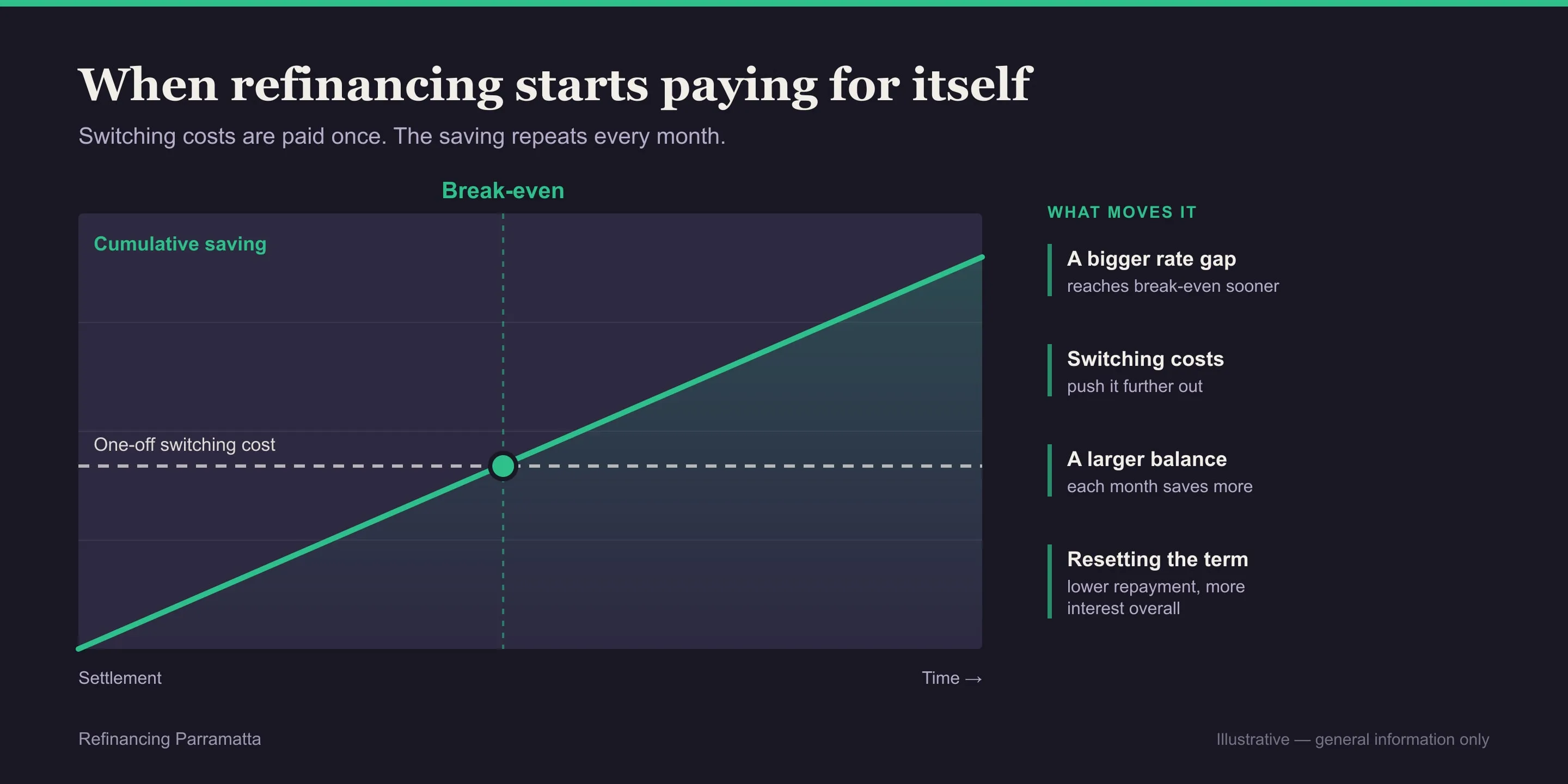
That single point decides a lot of refinances. A break cost on a fixed portion with two years left can wipe out several years of benefit, in which case the answer is to wait for the fixed term and prepare the move in advance rather than pay to escape it.
What we do is get the number and put it against the benefit over a realistic period. If the arithmetic does not clear, we say so. A broker with an incentive to move loans telling you not to move yours is worth more than one who never says it.
Taking Cash Out, and What Your Lender Will Ask
Refinancing to release equity, for a renovation, a deposit on a second Parramatta property or to consolidate debt, is a normal request, but it is assessed differently to a straight switch. Lenders want to know what the money is for, and they differ considerably in how much they will release and what evidence they want with the application.
Small amounts are often accepted on a stated purpose. Larger releases usually need documentation: quotes for the work, a contract, or a clear plan for the funds. Some lenders are relaxed and some are not, and a request that stalls with one is routine for another.
Debt consolidation deserves a word of caution rather than a sales pitch. Moving short-term debt into a mortgage lowers what you pay each month and stretches the debt over a much longer period, which can cost more overall. It is a genuinely useful tool in the right situation and the wrong answer in others, and we would rather work through which one you are in.
Equity, Buffers and Break Costs
How much equity can I actually access?
As a rule of thumb, about eighty per cent of the property’s value less what you still owe. Above eighty per cent most lenders require mortgage insurance, so the practical ceiling sits below the full amount of equity you have on paper.
The value used is a lender valuation rather than a listing estimate, and different lender panels can land on different figures on the same Parramatta address. Where you are near the eighty per cent line, which lender the application goes to genuinely matters.
Why would I be refused a refinance when I am meeting my repayments?
Because the new lender is not allowed to assess you on the rate you would pay. APRA requires an assessment three percentage points above it, and that buffer was held at three points in June 2026.
So the test you are being put through is harder than the loan you are actually servicing. Lenders vary in how they treat overtime, bonuses and existing commitments though, which is why a decline at one is not the answer for all of them.
What are break costs on a fixed loan?
A charge your lender calculates if you exit a fixed rate early, based on its own funding position rather than on a published schedule. Only your current lender can tell you the figure, and it changes over time.
It can be large enough to erase the entire benefit of moving. Where that is the case, the sensible plan is usually to prepare the refinance to complete when the fixed term ends rather than to pay your way out of it.
Can I refinance a home loan Parramatta to release cash for a renovation?
Usually, subject to having the equity and passing the assessment. What varies is how much a lender will release and what it wants to see: a small amount is often accepted on a stated purpose, while a larger release generally needs quotes or a contract.
It is worth knowing that lenders differ a lot here. A cash-out request that stalls with one lender can be routine for another, and choosing correctly at the start saves an application.
Should I consolidate my other debts into the mortgage?
Sometimes. It reduces what leaves your account each month and it simplifies things, which for a household under pressure is worth real money.
The trade is that a debt due to finish in three years gets stretched across the remaining term of the mortgage, and over that distance it can cost considerably more even at a much lower rate. We will run it both ways rather than sell you the version that looks better on the monthly figure.
Who Reviews Your Loan
The person who takes the call is the person who reads the statement and does the arithmetic. Nothing is passed to a processing team, so if the answer is that you should stay put, you hear it from the person who worked it out and can explain why.
Refinancing is where a broker most needs to be willing to give away the sale. That only works when the same person owns the relationship rather than a monthly target, which is a fair thing to ask about before you hand over a loan statement.
- Phone (02) 7813 2050
Quickest if you have a property in front of you and a question about it.
- Form Use the enquiry form
Better if you are on site or at work and cannot take a call back.
- Email info@mortgagebrokerparramatta.au
Suits a contract, a floor plan or a loan statement you want read.
Parramatta NSW 2150. Monday to Friday, 9am to 5pm.
Find Out Whether It Is Worth Moving
Send your latest loan statement and we will tell you whether another lender would take it, what the equity in your Parramatta home is worth against a real valuation, and what leaving your current loan would cost. If the answer is to stay, that is the answer you get.
Where We Work
- Business
- Mortgage Broker Parramatta
- Location
- Parramatta NSW 2150
- Phone
- (02) 7813 2050
- info@mortgagebrokerparramatta.au
- Hours
- Monday to Friday, 9am to 5pm