
B-02 / Yield, shading and structure
Investment Property Loans Parramatta
Two numbers decide most investment property loans Parramatta, and the interest rate is neither of them. The first is what type of property you buy, because the gap between what a unit yields here and what a house yields is wide enough to settle the arithmetic before anything else you choose does.
The second is what the lender does to your rent before counting it. It gets shaded for vacancy and costs, so the income the property produces and the income the bank credits you with are different figures, and only the second one decides your approval. We build the borrowing picture on that one.
What We Structure for You, and Why It Matters
An investment loan on a Parramatta property is assessed differently from an owner-occupied one at nearly every step. Your rental income is discounted, your existing debts weigh more heavily, and there is now a hard limit on how much high debt-to-income lending a bank can write. Getting the structure right at the start is worth more than shaving the rate later.
The decisions we work through with you are the ones with consequences: interest only or principal and interest, how much of your own equity to put in, which lender treats rental income and existing commitments most generously, and whether the next purchase after this one is still possible under the same structure.
We are not accountants or financial advisers, and negative gearing, depreciation schedules and ownership structures belong with yours. We work alongside them rather than around them, and we will tell you when a question is theirs rather than ours.
From First Numbers to Settlement on a Parramatta Purchase
You will want the capacity answer before anything else, so that comes first. Nothing is lodged until the structure is settled.
-
We work out real capacity
Your income, your existing loans, and rental income shaded the way a lender shades it. What comes back is what you can borrow now and where the ceiling sits, which is usually the number that decides what you go looking at.
-
We work through the structure
Interest only against principal and interest, how much equity to release, which lender to use and what that leaves possible next time. The options get laid out with the consequences attached rather than a recommendation with no working.
-
You see the holding costs, not just the loan
Land tax if the holding takes you over the threshold, strata levies on a Parramatta unit, and what the shaded rent covers against what it does not. A property that looks fine on yield alone can look different once those are in.
-
We lodge and run it through
Application with the lender whose policy reads your file best, valuation, the assessor’s questions and settlement with your conveyancer. If you are buying at auction we will work to the date.
Useful to have to hand: your current loan statements, recent payslips or returns, any existing rental income, and the land values on property you already own if there are any. The first conversation needs none of it.
What You Will Want to Ask Us First
How long before I have real numbers to work with?
The borrowing capacity figure comes out of the first proper conversation, once we have your income, your existing loans and a realistic rent for the sort of property you are looking at.
A pre-approval is a matter of days after that in most cases. If you are bidding at auction, tell us the date and we will work backwards from it.
Who pays you, and does it cost me anything?
It costs you nothing. The lender pays us a commission when the loan settles, it is not added to the loan and it does not come out of your deposit, and it is the same arrangement whether the property is an investment or somewhere you intend to live.
If a fee ever applied to your circumstances, it would be set out in writing in our Credit Guide before you decided whether to go ahead.
Will you work with my accountant?
Yes, and on investment files it usually produces a better outcome. Ownership structure, negative gearing and depreciation are your accountant’s territory, and the loan structure has to fit whatever they advise rather than the other way round.
Where a question is properly theirs we will say so instead of offering an opinion. A broker giving tax advice is a problem waiting to happen.
What happens if I already have loans elsewhere?
It makes the assessment more involved but it is ordinary work. Existing loans count against your capacity, and how heavily depends on the lender, which is one of the reasons a second or third purchase often needs a different lender from the first.
Bring the statements. Existing debt structured badly is one of the most common reasons a capable investor is told no, and it is frequently fixable.
How Rent Is Counted on Investment Property Loans Parramatta
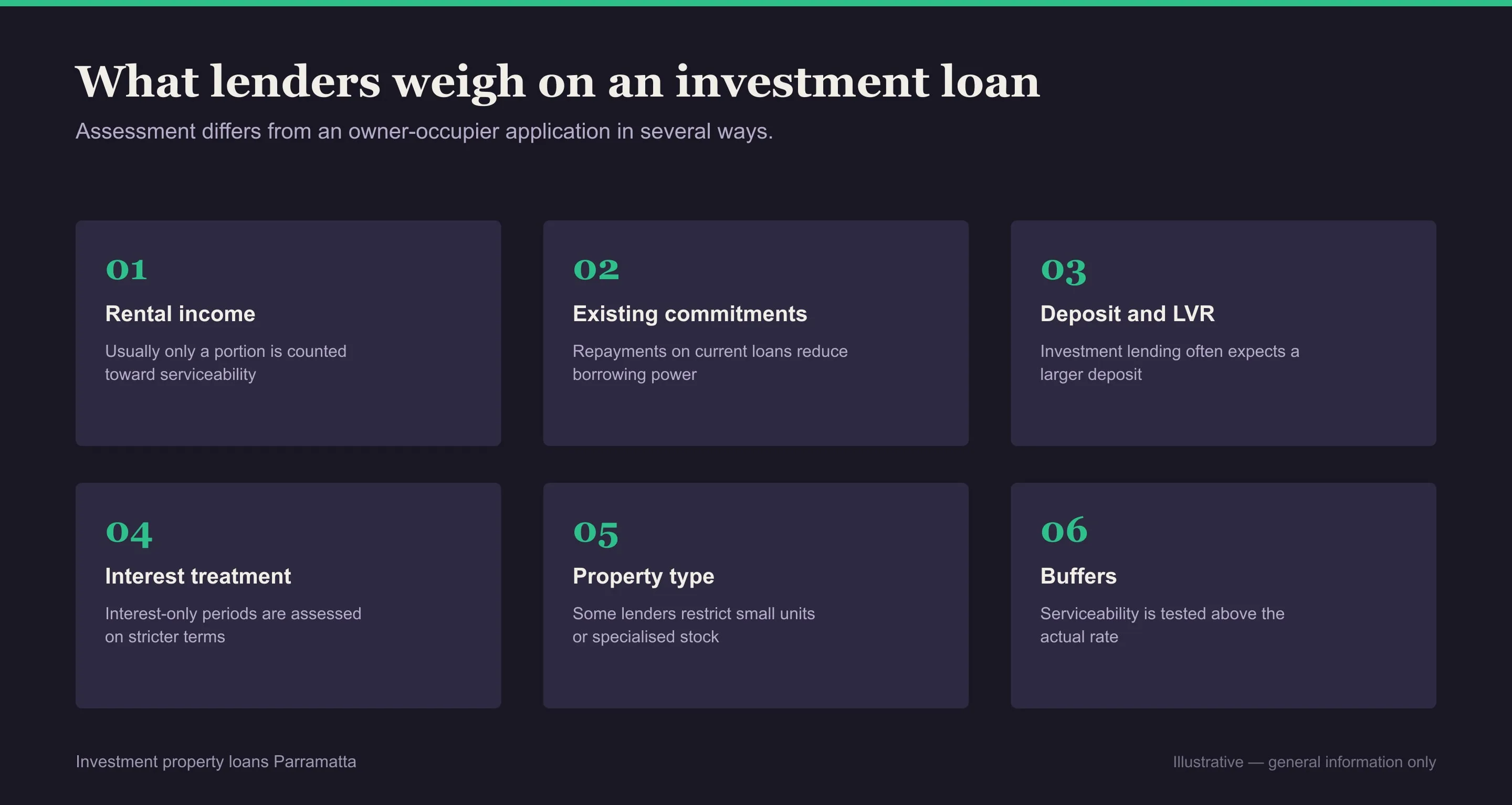
A lender does not count the full rent. Twenty to twenty-five per cent is typically shaded off before the income touches your assessment, to allow for vacancy, management fees, rates, insurance and repairs. On a Parramatta unit returning a solid yield that discount removes a meaningful slice of the income you were counting on.
The consequence is that two investors with identical properties can get different answers depending on where they apply, because the shading percentage and the treatment of other commitments vary between lenders. It is one of the few places where lender selection changes the borrowing figure rather than just the price.
It also means a spreadsheet built on gross rent will overstate what you can borrow, sometimes badly. We would rather give you the shaded number early, even when it is smaller than the one you arrived with, than have an application fall over on a figure that was never going to hold.
The Debt-to-Income Cap and What It Means for Your Portfolio
From February 2026, APRA limits how much lending at a debt-to-income ratio of six or above a bank may write, capping it at twenty per cent of new lending. Debt-to-income is total debt against total income, so it counts every loan you hold, not only the one you are applying for.
This is a portfolio constraint, not a single-purchase one. An owner-occupied mortgage plus one investment property is often enough that a third purchase pushes your ratio over six, at which point the lender is rationing a limited allowance rather than assessing you on merit. The file can be strong and still not fit inside the quota.
Planning around it is possible if it is thought about before you buy rather than after. How much equity goes in, whether debt is paid down first, which lender has room and in what order the purchases happen all move the ratio. That planning is worth having on the second property, not the fourth.
Interest Only, and What You Are Actually Choosing
Interest only keeps your outgoings lower during the term and preserves cash flow, which is why it is common among investors and why some accountants prefer it. What it does not do is reduce the debt, so at the end of the interest only period the same balance has to be repaid over a shorter remaining term, and the repayment steps up.
Lenders assess that step-up. The application is tested on your ability to service principal and interest over the reduced term, not on the lower payments you would be making, which means an interest only loan is often harder to qualify for than the equivalent principal and interest loan rather than easier.
Neither choice is right in general. It depends on your cash flow, your tax position and how long you intend to hold. We will run both, and where the answer turns on tax rather than on finance we will say so and point you to your accountant.
Land Tax, and When It Reaches You
NSW land tax applies once the combined land value of your taxable holdings passes the general threshold, which is $1,075,000. Your principal residence is generally exempt, so for most investors it is the investment property that brings the liability into existence.
The detail that matters is that the threshold has been frozen rather than indexed. As land values rise, more holdings drift over a line that is no longer moving with them, so a Parramatta holding comfortably under the threshold today can be over it in a few years without a single further purchase.
It is charged on land value rather than on the property’s market value, which is part of why a unit and a house at similar prices can carry very different land tax exposure: an apartment’s share of the land is small. That interacts with the yield gap in ways worth thinking about before choosing between the two, and it is a real reason to take the question to your accountant early.
Rent, Debt Limits and Land Tax
How much of my rental income will a lender count?
Usually seventy-five to eighty per cent of it. The rest is shaded off to allow for vacancy, management fees, rates, insurance and maintenance, and the shading applies before your servicing is calculated.
The exact percentage varies between lenders, and so does the treatment of your existing commitments. Together those differences are large enough to change what you can borrow, not just what you pay for it.
Are units or houses the better buy for an investor here?
On yield the difference is stark. Units in Parramatta run at a gross yield of about 5.75% against roughly 2.28% for Parramatta houses, which is a serviceability advantage as well as an income one, because shaded rent still helps you qualify.
Houses have historically carried more of the capital growth and hold more land value, which cuts both ways once land tax enters the picture. The right answer depends on whether you are buying for cash flow or for growth, and that is a question to settle before you look at listings.
What is the debt-to-income cap and does it affect me?
From February 2026, banks may write no more than twenty per cent of their new lending at a debt-to-income ratio of six or above. It counts all your debt against all your income, so it bites hardest if you already hold property.
If you are buying your first investment it probably does not reach you. If it is your third, it may be the constraint that decides which lender you can use and how much equity needs to go in.
When do I start paying land tax?
When the combined land value of your taxable NSW holdings passes the general threshold of $1,075,000. Your own home is generally exempt, so it is normally the investment property that creates the liability.
The threshold has been frozen rather than indexed, so rising land values quietly pull more owners over it each year. It is assessed on land value rather than market value, which is why apartments and houses at similar prices can produce very different bills.
Do investment property loans Parramatta need a bigger deposit?
Often, though it is driven by servicing more than by a fixed rule. Many lenders will go to ninety per cent on an investment purchase with mortgage insurance, but the shaded rent and the tighter assessment mean plenty of investors are capped below that by capacity rather than by policy.
Where the property is a unit, the building itself can also set the ceiling. That is a separate check and it is worth running before you bid.
Who Structures Your Loan
One broker across your whole Parramatta portfolio rather than a new person for each purchase. On an investment file the decisions made on the second property determine what is possible on the third, and that context only survives if the same person holds it.
It also means the conversation can be a blunt one. If a purchase would push your debt-to-income ratio somewhere you do not want to be, that is worth hearing before you go to an auction rather than after.
- Phone (02) 7813 2050
Quickest if you have a property in front of you and a question about it.
- Form Use the enquiry form
Better if you are on site or at work and cannot take a call back.
- Email info@mortgagebrokerparramatta.au
Suits a contract, a floor plan or a loan statement you want read.
Parramatta NSW 2150. Monday to Friday, 9am to 5pm.
Get the Capacity Number First
Tell us what you own, what you owe and what you are looking at in Parramatta, and we will come back with what you can borrow on a shaded rental figure, what the structure options cost you and where the ceiling on the next purchase sits.
Where We Work
- Business
- Mortgage Broker Parramatta
- Location
- Parramatta NSW 2150
- Phone
- (02) 7813 2050
- info@mortgagebrokerparramatta.au
- Hours
- Monday to Friday, 9am to 5pm